Agentic. Agentic Agentic.
Primary role: Director Experience Design
Team: Penelope Trenholm (product manager) Thomas Kroll (UX designer), Enna Post Gutierrez (researcher), Jenn Hanley (visual designer)
Contribution: Experience vision, vision video, general guidance.
The buzziest of buzz words in this tidal wave of AI has to be “agentic.” It gets thrown around a lot - but for good reason - as it represents a massive leap forward in how things get done. There is plenty of value in generative AI, and these concepts/technologies/architecture are not mutually exclusive. In fact, generative AI is the decision engine behind an agentic architecture, it just often gets referenced in the context of text and image generation. It’s under the hood of a good agentic experience.
The buzziest of buzz words in this tidal wave of AI has to be “agentic.”
You’ll be hard-pressed to find a more meaningful - and game changing - application of an agentic experience than cash forecasting. Cash flow is everything to a business, and understanding your situation is key to survival. We saw huge potential for AI to positively impact the bottom line for Oracle NetSuite businesses.
Below is the vision design first shared at SuiteWorld 2024.
A great AI experience is seamlessly part of the product, not a sidebar chatbot.
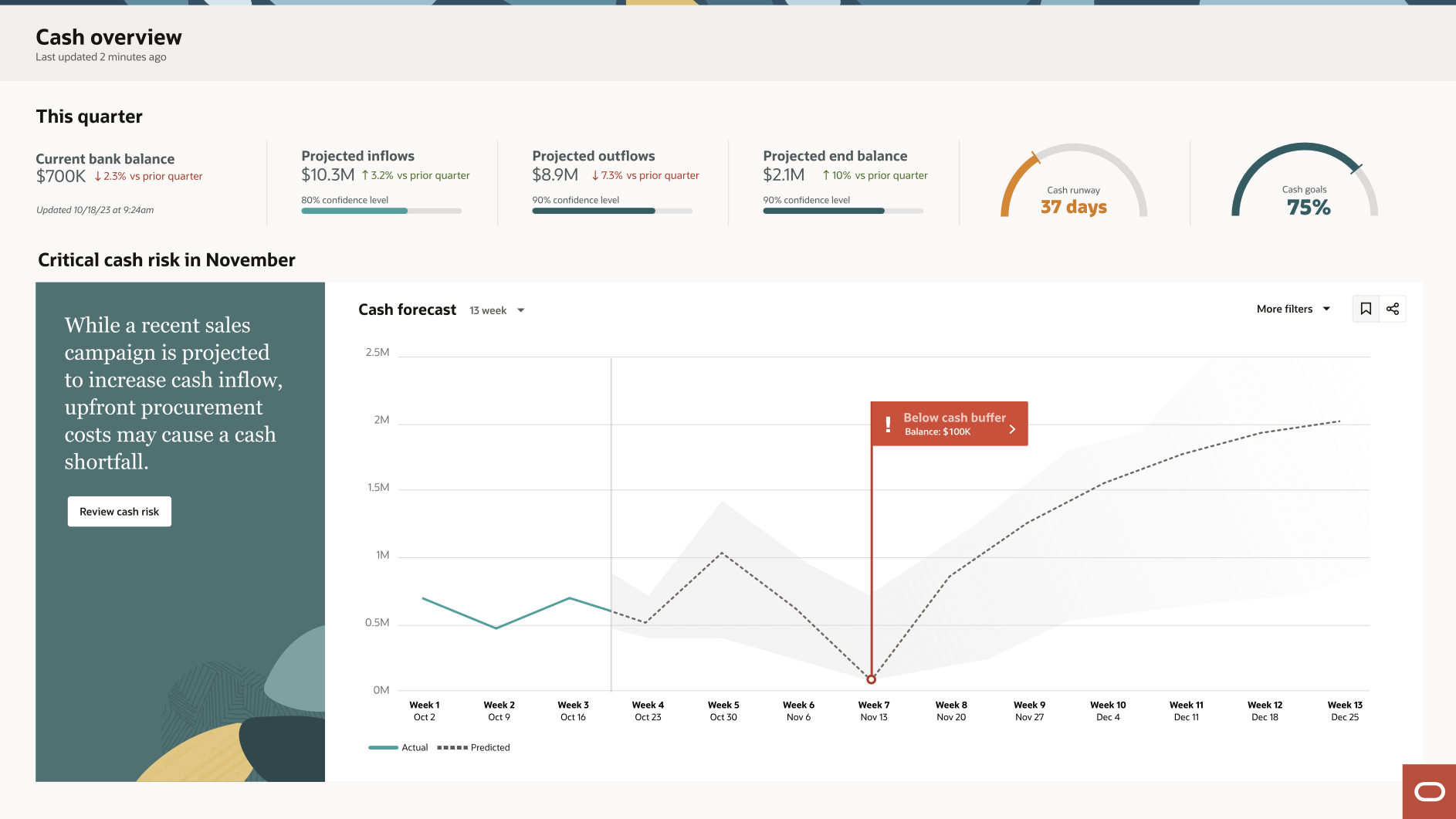
As a proactive agentic experience, the system knows your preferred cash buffer and is tracking your inflows and outflows.
The scenario: Our example business is called “Wyra,” a start-up selling smart indoor bikes. It tracks its sales campaigns carefully, as there is a lot of money going in and out.
Thanks to Netsuite AI, they are alerted to a potential cash shortfall resulting from a campaign’s high upfront procurement costs. It is projected to drive strong revenue, but the initial costs would drop the company below their cash buffer.
With natural language, and a guided experience, the system alerts them to the cash risk and provides an intuitive workflow to resolve it.
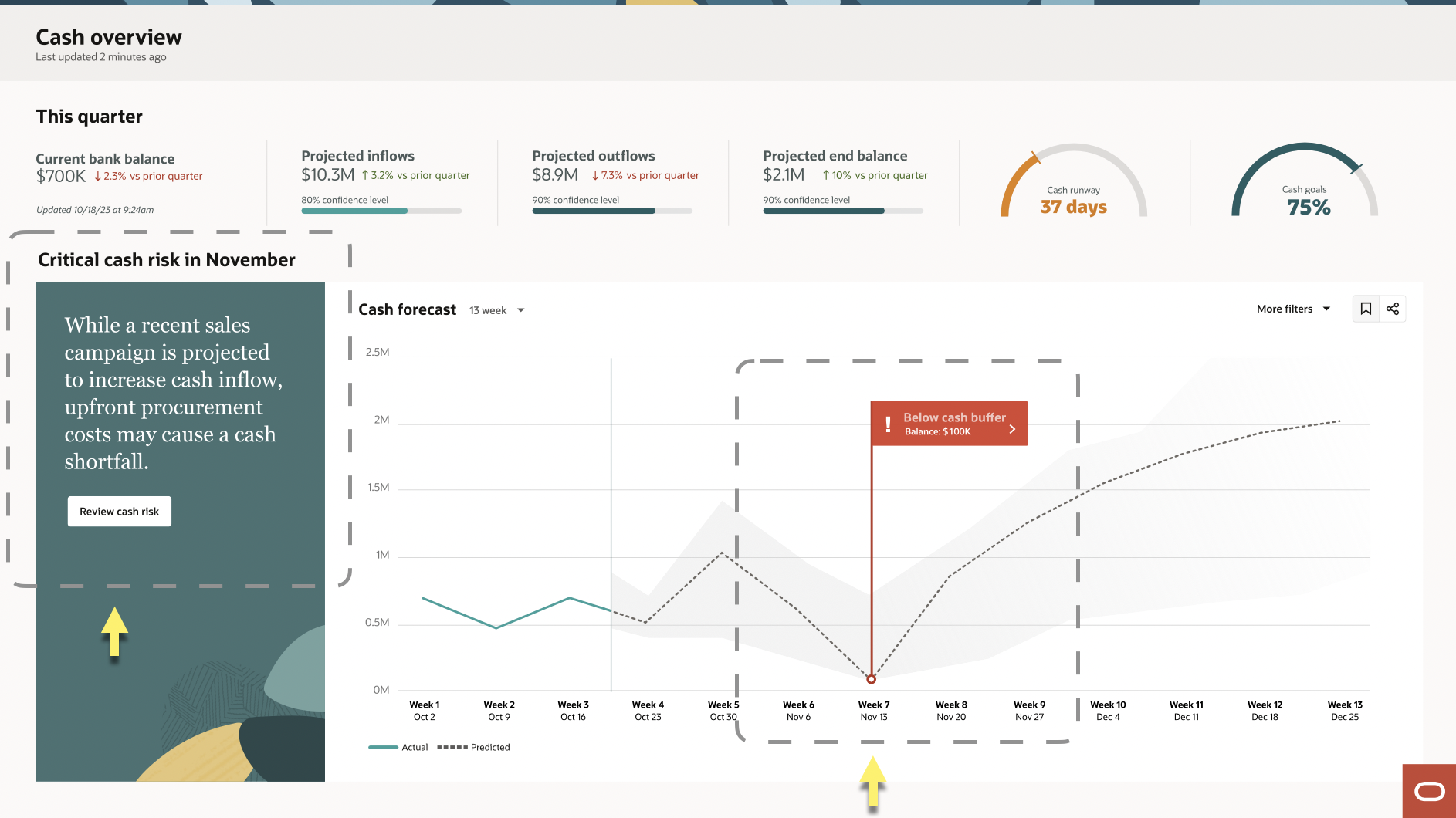
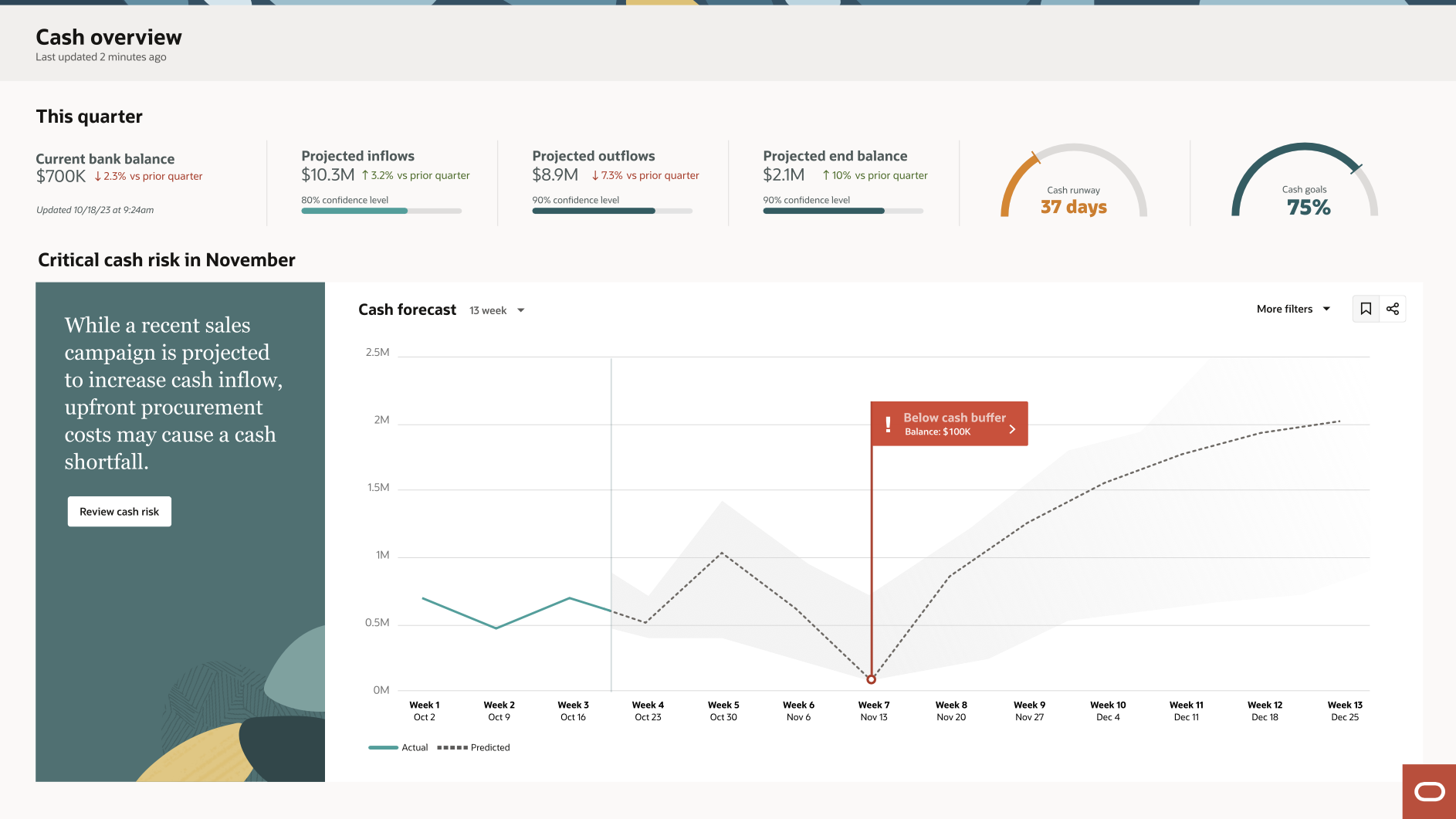
AI can tell customers a story, not just display an abstract UI and hope they get it.
Notice the obvious story narrative bar on the left, and the graph calling out the cash shortfall to the right. The vision is to have an agentic experience interwoven into dashboards that historically have been minimally interactive (and non-assistive).
The great thing about a vision is you can play with interactive elements that are conceptual in nature. They might take time to build, or ultimately be unnecessary, but sometimes you find something worth exploring. The tree map pattern at the top of the page (below) is one we had been working on for some time, trying to see how it might provide value to our customers.
Visualizing high variance data is tricky, because you can have $.10 transactions and $10,000 transactions, and everything in between.
We had folks strongly pushing for each cell to represent individual transactions, but the relative sizes for each one would be very problematic. However, if you grouped transactions by - say - month, then relative sizing of cells wouldn’t be so hard.
For the treatment below, we visualized inflows and outflows, with cells representing different types of transactions (customer payments, payroll, taxes, etc.). It’s an interesting concept that we continued to put in front of customers for feedback.
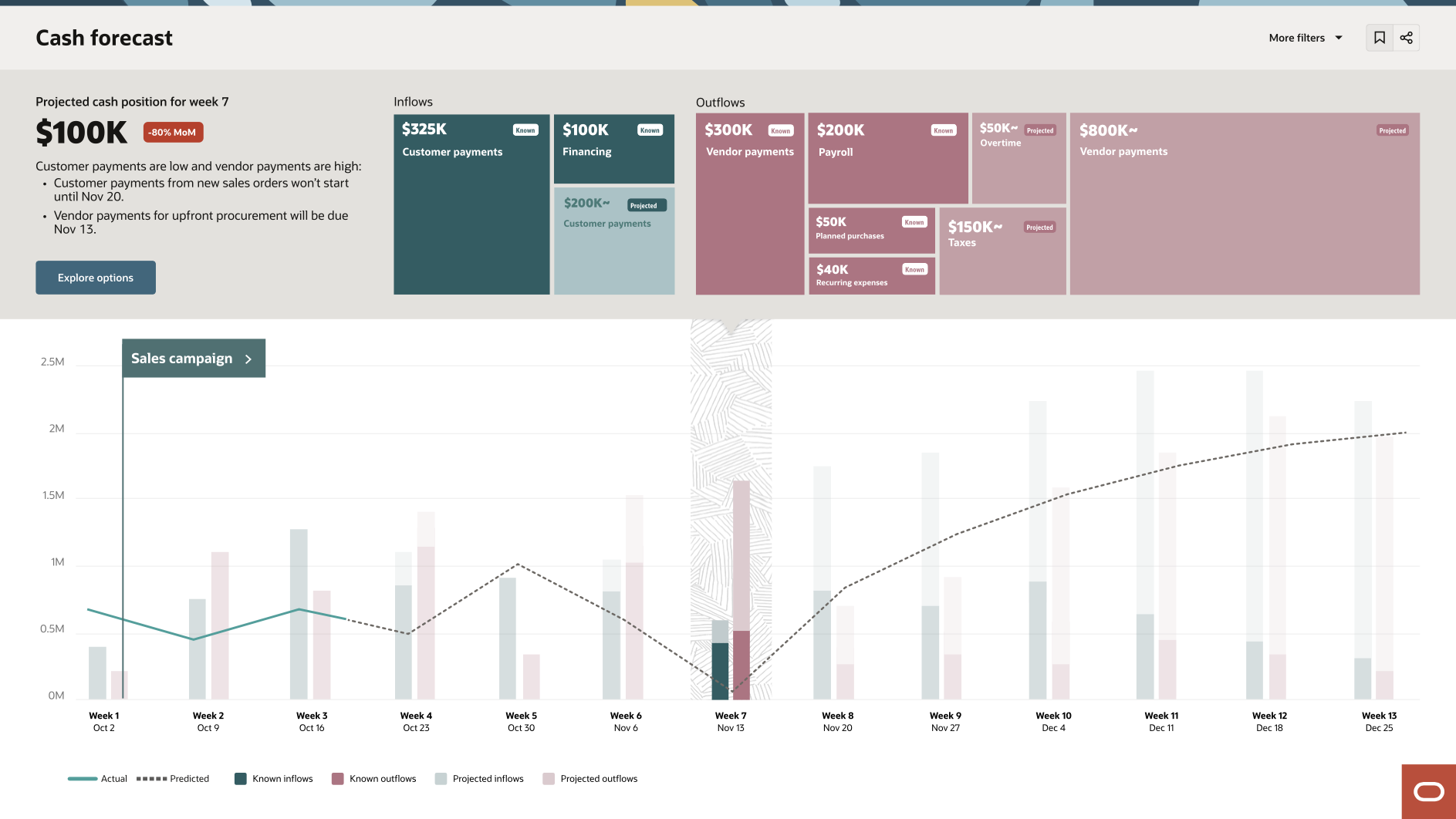
In the context of our scenario, you can see outflows are much higher than inflows, and the projected cash position is poor. This being a concept, and not yet a shipped product, the notion of multiple campaigns running concurrently has not been designed for yet.
Now, onto the coolest part of this experience. Pointing out there could be a cash shortfall is good, but you know what is better? Providing options of how to handle it. With a system that knows your vendor agreements, forecasted receivables, details about your products, and is connected to financial services - it can suggest ways to address your shortfall.
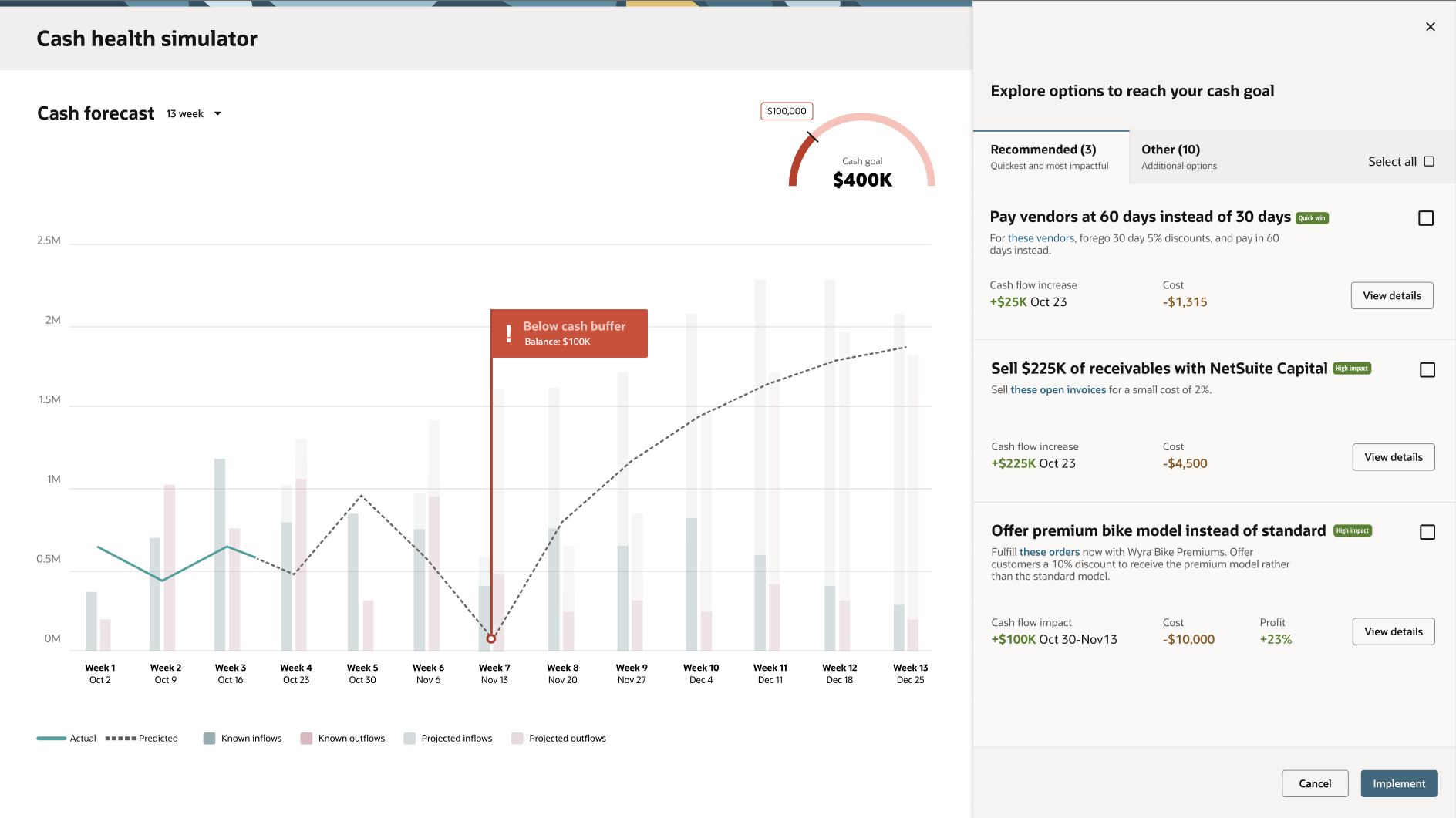
Smart system, smart suggestions.
What you’re looking at here is a simulator - a way to explore business options and see how it impacts the bottomline. What if I pay vendors 30 days later? Or essentially get a cash advance for receivables? Having all the data in one suite makes this concept much more achievable.
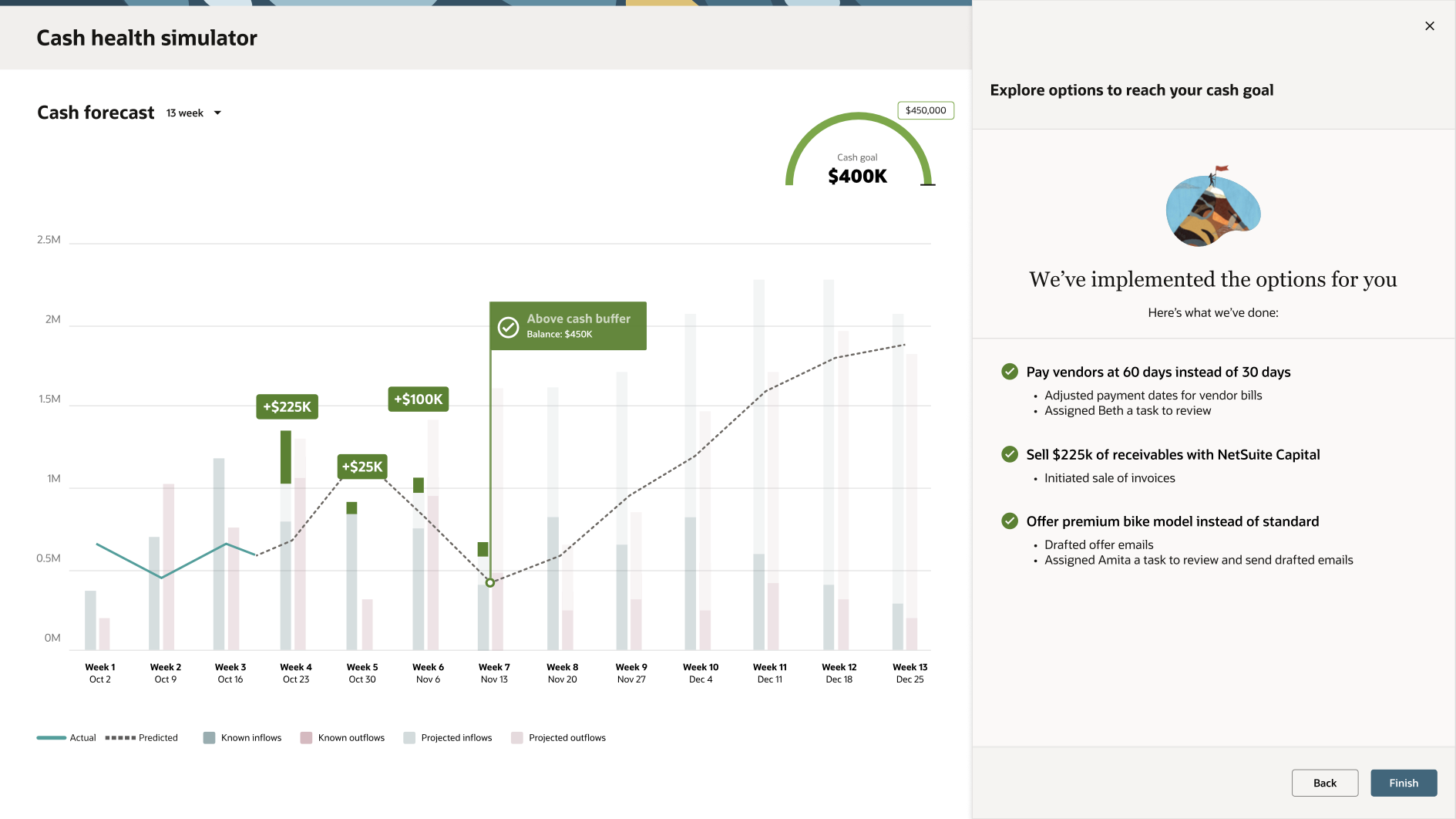
A playground that becomes reality.
So, you chose the three options presented to you: pay vendors later, sell receivables, and offer a premium bike model. The system applies these choices, and the projected shortfall is avoided. Yes, it’s a concept and idealized, but the potential is unequivocally there.
Addendum
Now, let’s look at some of the work done well prior to this experience. More than four years ago - in the pre-explosion era of AI - I worked with a small strategy team to advance the story of an intelligent system informed by our suite-wide data. We wanted to tell a story of humanity - the evolution of tools over time.
We took it back to the Lydians in 7th century BC - we’re talking the invention of money! - and worked our way up to intelligent computer systems making recommendations.
But our video started with some cold hard statistics on small businesses, because we wanted to drive home the point of why this was all needed.
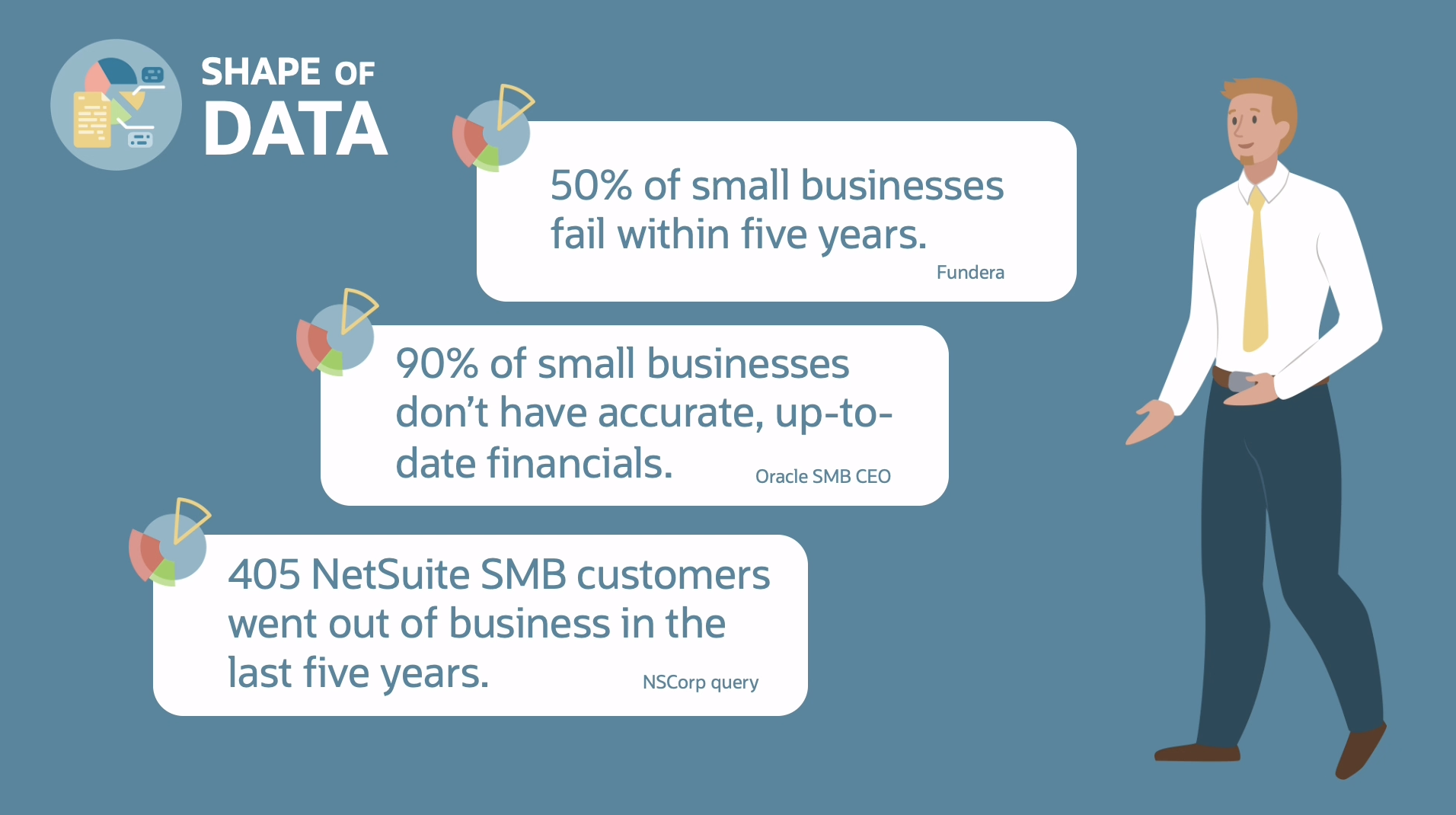
The shape of small businesses can be rough.
Businesses often die because they fail at cash forecasting, have severe cash flow problems, poor profitability, etc. The promise of an agentic system that helps with planning, forecasting sales, and predicting cash shortfalls was huge.
Vision Video
I wrote the copy, did the voice over, and put together the video. Joty Brar and Andrew Hery were the strategic product thinkers, and Jenn Hanley created the imagery, advised on the script, and provided overall perspective.
Here’s one segment of it. What started with a PowerPoint, ended with me stretching the animation limits of that program!
Cash is King, Queen and a royal challenge.
The point we were making here is that figuring out your cash flow is hard and complicated. If a system like Oracle-NetSuite has all the data, why can’t it help with this painful process?
We shared the full video with leadership, and there was strong positive feedback. It was no more than a year later than AI started really lifting off, and our team started taking this story and turning it into reality.